
-
Pick up from the Woodmart Store
To pick up today
Free
-
Courier delivery
Our courier will deliver to the specified address
2-3 Days
Free
-
DHL Courier delivery
DHL courier will deliver to the specified address
2-3 Days
Free
Hurry and get discounts on all Apple devices up to 20%
Sale_coupon_15
€1,092.81
To pick up today
Free
Our courier will deliver to the specified address
2-3 Days
Free
DHL courier will deliver to the specified address
2-3 Days
Free
Payment Methods:
Price: €1,092.81
(as of Feb 27, 2026 13:42:48 UTC – Details)

To calculate the overall star rating and percentage breakdown by star, we don’t use a simple average. Instead, our system considers things like how recent a review is and if the reviewer bought the item on Amazon. It also analyses reviews to verify trustworthiness.Learn more how customers reviews work on Amazon
Excellent Monitor
Reviewed in the United States on 10 October 2020
Long Review, forgive me!
Wow, ok guys, I got to tell ya…..this Acer Predator XB323U GP monitor is really really good. Let me give you a little back story really fast though. I am replacing my Acer Predator XB271HU and I am currently testing a Dell S2721DGF at the same time I am testing this XB323U. So I am comparing two really good monitors right now, 1 will stay on my desk and the other goes back. These are my initial thoughts after owning this monitor for the past 36-48 hours.
So the XB323U arrived, in a massive box by the way. The box was like 35 pounds or something. The monitor is fully assembled when you take it out and that probably explains why it is so big. It comes with a headset holder that you attach to the stand and it comes with a DP 1.4 cable, HDMI 2.0 cable, and a USB cable so you can use the USB ports on the monitor. I personally bought an extra longer DP 1.4 cable so I could better cable manage around my desk. So that is what comes in the box…..no assembly required. The stand is made of metal, not plastic, and feels very durable. The entire build quality of the monitor definitely feels premium, kind of like buying a really nice Lexus over a base model Honda to compare.
So here are my initial impressions upon turning it on. Forgive me because I will make a few comparisons to the Dell S2721DGF throughout this review which I am sure most won’t mind because that is a kick ass monitor too. This is a AHVA IPS panel on the XB323U and it is really good. The Dell has a LG nano IPS panel in it. The Dell has an extremely vibrant color set out of box and I recommend anyone buying one to use custom color settings. My XB323U came and appears to be calibrated out of box. On standard color settings the only thing I did was up the brightness to around 75 and contrast to around 50. I like to use the Eizo Monitor Testing suite to see how well my monitors perform for initial testing. I had a perfect pattern tests as lines were straight and colors looked great and faded perfectly. I had zero dead or stuck pixels and one of the most important things is I had virtually zero back light bleed with my panel minus an almost unnoticeable area on the bottom right side of the screen. I am nit picking here because unless you are in a pitch black room with an all black screen it’s virtually unnoticeable. IPS glow is minimal but only noticeable if the entire screen is black. To be honest, I was extremely surprised at how well the black contrasts on this monitor are. For IPS, at least on this one I got, the blacks are super on this monitor…..bravo Acer! I’ve had my fair share of TN and IPS monitors and this is the best one I’ve seen to date. Keep in mind it varies from monitor to monitor. One important thing for me is black and color uniformity throughout the panel and how well the panel is evenly lit across. Without having actual test equipment, I perceive no lighter or darker areas on the monitor and colors seem fantastic. This seems to be one of the best uniformed panels I have owned to date. Also my gamma seemed to be on point at 2.2 using the Eizo Monitor Testing suite.
For productivity work using Excel, Word, CAD, Chrome and Edge, etc. the size of this screen is very enjoyable and easy on the eyes. Text in all font sizes is clear and sharp. I like the extra size and real estate to have multiple windows open and toggle between them side by side. On smaller monitors you can’t really do this effectively. This is much more enjoyable to work on than the Dell S2721DGF. Also, watching videos on YouTube and Netflix was enjoyable and should provide a great experience for anyone wanting to play media on this monitor.
For gaming, this is where the monitor really shines. My gaming rig uses a 8700k OC’ed to 4.8ghz on all cores, 32gb 3200mhz Corsair Vengeance memory, and a EVGA RTX 2080 XC Ultra. I spent a solid 8 hours last night putting this monitor through a variety of games I play a lot such as CS:GO, PUBG, Battlefield 5, Apex, Rogue Company, PGA Tour 2k21, Diablo 3, and League of Legends. I am an avid CSGO and PUBG player so those stick out the most to me during my testing. For me, I think Acer did right on this panel to cap it at 170hz as it provides buttery smooth game play, with GSYNC on and off. If you play with GSYNC “off” screen tearing is not even noticeable especially you are pushing 160fps+ however if you are averaging lower fps like around 100 you should be using GSYNC to maximize your experience with this monitor. I can’t perceive any additional input lag while using GSYNC but I tend to keep it off anyways because I can drive high frame rates. Out of box this monitor is configured to run 170hz automatically as long as you use a display port 1.4 cable. The monitor comes with 3 overdrive settings: off, normal, extreme. Normal overdrive is the best setting I found and ghosting is non-existent. The input lag and responsiveness is seriously excellent and will make serious gamers very happy. On a side note, there is a setting in the OSD called “Ultra Low Latency”…..DO NOT turn this off. It is on by default and is important to keep your input lag low…..I am not sure why anyone would turn it off anyways…..just don’t touch it! In regards to HDR content, I am a little new to the HDR world. I did fire up Battlefield 5 and turn HDR on it things seemed a little more vibrant and bright. HDR is something I am going to have to play with a little more to see how to fully utilize it so my initial thoughts here are just that. I will add more to this post later about HDR. Just know that with HDR turned off the maximum brightness is 400nits and with HDR enabled it is 600nits and there is some sort of zone dimming on the edges otherwise this could not have achieved Vesa’s HDR600 rating. This is a really fast IPS panel and is definitely a step up in speed compared to my old Acer Predator XB271HU (still a great monitor btw!). Comparing my gaming experience to the Dell S2721DGF I am testing is so similar. I can honestly say that the Dell using the LG nano IPS technology feels really great for FPS gaming on a 27inch but there is something about the immersive experience I get on this XB323U that makes it stand out above the Dell. I think it’s the size, brightness, and how well the black contrast and uniformity is that makes it seem better. I will say though, the Dell has a little better black equalizer option in the OSD.
If you are worried about the 93 PPI on a 32inch 1440p monitor, don’t worry. I sit a few feet away and can not see any pixels. If you sit with your face in the monitor you will see pixels and probably destroy your eyes so make sure you sit 3-4 feet away or more and you’ll notice the image and pixel density is really perfect. It compliments the resolution and size of the monitor very well. So for those PPI nerds out there, chill out…..this monitor looks fabulous. Also, I know people are itching to get 240hz 1440p panels but please be realistic in what you ask for. Most gamers are not going to be able to take advantage of true 240hz 1440p gaming and secondly to pay additional money for an almost unnoticeable difference is a throw away unless you are in the top %0.5 of gamers who need every last millisecond to compete on a professional stage. I am a monitor snob and I have bought and returned a few 1080p 240hz panels over the past year and the feel between 170hz and 240hz is almost imperceivable. This is the XB323U GP and the XB323U GX 240hz is supposed to come out after the 1st of the year….bare in mind that the GX is supposed to only be a HDR400 monitor too so there is a trade off depending on what you seek.
In conclusion, the Acer Predator XB323U is really a fantastic monitor. I was worried about buying this at first because this is a brand new release and no reviews were anywhere to be found. So I took a leap of faith and I am really glad I did. I will be returning the Dell S2721DGF to BestBuy and this XB323U will remain on my desk as my new primary monitor. I am excited to see TFTCentral or RTINGS.com do a review on this to see how they rate it. I know it’s going to be good. I think this monitor will compete very well against the Samsung 32inch G7 without all the issues the G7 has. If anyone is on the fence in regards to this monitor, don’t be. It is a premium monitor and it’s price seems justified to me. This will suite you well in productivity, media, and gaming…..even those serious gamers.
UPDATE: I have had more time to play around with HDR on this monitor and I must say watching HDR content on this monitor is extremely enjoyable. It's so immersive and the colors are so life like….you almost feel like you could reach out and touch what ever you are viewing. The zone dimming is fantastic on this panel and blacks look very good and mesh well with vibrant colors. Everything is so sharp and crisp. In regards to HDR gaming, after playing around with HDR settings in some games, I don't think HDR gaming is fully there yet in video games. I messed around with BF5, Shadow of Tomb Raider, and No Man's Sky……..HDR just didn't seem to pop for me in those games. Was there improvement, yes but not like the experience you get while watching HDR videos and movies. It is very important to know that you need to turn HDR "on" in the screen menu before turning on HDR on in the windows Display Settings……otherwise you won't experience HDR to its fullest. I've set up a profile for gaming with HDR turned off and a profile for HDR that I swap between on the monitor. I love it, seriously love this monitor.
16 JAN 2020 UPDATE: Almost 3 months in using this monitor and I love it. I love it so much that I am tempted to pick up a 2nd one and go dual display. Colors are great, response times are great, gaming on it feels fantastic. This a great all around monitor and should fill the 1440p big screen gap for a lot of folks out there.
5.0 out of 5 stars
Reviewed in the United States on 10 October 2020
Long Review, forgive me!
Wow, ok guys, I got to tell ya…..this Acer Predator XB323U GP monitor is really really good. Let me give you a little back story really fast though. I am replacing my Acer Predator XB271HU and I am currently testing a Dell S2721DGF at the same time I am testing this XB323U. So I am comparing two really good monitors right now, 1 will stay on my desk and the other goes back. These are my initial thoughts after owning this monitor for the past 36-48 hours.
So the XB323U arrived, in a massive box by the way. The box was like 35 pounds or something. The monitor is fully assembled when you take it out and that probably explains why it is so big. It comes with a headset holder that you attach to the stand and it comes with a DP 1.4 cable, HDMI 2.0 cable, and a USB cable so you can use the USB ports on the monitor. I personally bought an extra longer DP 1.4 cable so I could better cable manage around my desk. So that is what comes in the box…..no assembly required. The stand is made of metal, not plastic, and feels very durable. The entire build quality of the monitor definitely feels premium, kind of like buying a really nice Lexus over a base model Honda to compare.
So here are my initial impressions upon turning it on. Forgive me because I will make a few comparisons to the Dell S2721DGF throughout this review which I am sure most won’t mind because that is a kick ass monitor too. This is a AHVA IPS panel on the XB323U and it is really good. The Dell has a LG nano IPS panel in it. The Dell has an extremely vibrant color set out of box and I recommend anyone buying one to use custom color settings. My XB323U came and appears to be calibrated out of box. On standard color settings the only thing I did was up the brightness to around 75 and contrast to around 50. I like to use the Eizo Monitor Testing suite to see how well my monitors perform for initial testing. I had a perfect pattern tests as lines were straight and colors looked great and faded perfectly. I had zero dead or stuck pixels and one of the most important things is I had virtually zero back light bleed with my panel minus an almost unnoticeable area on the bottom right side of the screen. I am nit picking here because unless you are in a pitch black room with an all black screen it’s virtually unnoticeable. IPS glow is minimal but only noticeable if the entire screen is black. To be honest, I was extremely surprised at how well the black contrasts on this monitor are. For IPS, at least on this one I got, the blacks are super on this monitor…..bravo Acer! I’ve had my fair share of TN and IPS monitors and this is the best one I’ve seen to date. Keep in mind it varies from monitor to monitor. One important thing for me is black and color uniformity throughout the panel and how well the panel is evenly lit across. Without having actual test equipment, I perceive no lighter or darker areas on the monitor and colors seem fantastic. This seems to be one of the best uniformed panels I have owned to date. Also my gamma seemed to be on point at 2.2 using the Eizo Monitor Testing suite.
For productivity work using Excel, Word, CAD, Chrome and Edge, etc. the size of this screen is very enjoyable and easy on the eyes. Text in all font sizes is clear and sharp. I like the extra size and real estate to have multiple windows open and toggle between them side by side. On smaller monitors you can’t really do this effectively. This is much more enjoyable to work on than the Dell S2721DGF. Also, watching videos on YouTube and Netflix was enjoyable and should provide a great experience for anyone wanting to play media on this monitor.
For gaming, this is where the monitor really shines. My gaming rig uses a 8700k OC’ed to 4.8ghz on all cores, 32gb 3200mhz Corsair Vengeance memory, and a EVGA RTX 2080 XC Ultra. I spent a solid 8 hours last night putting this monitor through a variety of games I play a lot such as CS:GO, PUBG, Battlefield 5, Apex, Rogue Company, PGA Tour 2k21, Diablo 3, and League of Legends. I am an avid CSGO and PUBG player so those stick out the most to me during my testing. For me, I think Acer did right on this panel to cap it at 170hz as it provides buttery smooth game play, with GSYNC on and off. If you play with GSYNC “off” screen tearing is not even noticeable especially you are pushing 160fps+ however if you are averaging lower fps like around 100 you should be using GSYNC to maximize your experience with this monitor. I can’t perceive any additional input lag while using GSYNC but I tend to keep it off anyways because I can drive high frame rates. Out of box this monitor is configured to run 170hz automatically as long as you use a display port 1.4 cable. The monitor comes with 3 overdrive settings: off, normal, extreme. Normal overdrive is the best setting I found and ghosting is non-existent. The input lag and responsiveness is seriously excellent and will make serious gamers very happy. On a side note, there is a setting in the OSD called “Ultra Low Latency”…..DO NOT turn this off. It is on by default and is important to keep your input lag low…..I am not sure why anyone would turn it off anyways…..just don’t touch it! In regards to HDR content, I am a little new to the HDR world. I did fire up Battlefield 5 and turn HDR on it things seemed a little more vibrant and bright. HDR is something I am going to have to play with a little more to see how to fully utilize it so my initial thoughts here are just that. I will add more to this post later about HDR. Just know that with HDR turned off the maximum brightness is 400nits and with HDR enabled it is 600nits and there is some sort of zone dimming on the edges otherwise this could not have achieved Vesa’s HDR600 rating. This is a really fast IPS panel and is definitely a step up in speed compared to my old Acer Predator XB271HU (still a great monitor btw!). Comparing my gaming experience to the Dell S2721DGF I am testing is so similar. I can honestly say that the Dell using the LG nano IPS technology feels really great for FPS gaming on a 27inch but there is something about the immersive experience I get on this XB323U that makes it stand out above the Dell. I think it’s the size, brightness, and how well the black contrast and uniformity is that makes it seem better. I will say though, the Dell has a little better black equalizer option in the OSD.
If you are worried about the 93 PPI on a 32inch 1440p monitor, don’t worry. I sit a few feet away and can not see any pixels. If you sit with your face in the monitor you will see pixels and probably destroy your eyes so make sure you sit 3-4 feet away or more and you’ll notice the image and pixel density is really perfect. It compliments the resolution and size of the monitor very well. So for those PPI nerds out there, chill out…..this monitor looks fabulous. Also, I know people are itching to get 240hz 1440p panels but please be realistic in what you ask for. Most gamers are not going to be able to take advantage of true 240hz 1440p gaming and secondly to pay additional money for an almost unnoticeable difference is a throw away unless you are in the top %0.5 of gamers who need every last millisecond to compete on a professional stage. I am a monitor snob and I have bought and returned a few 1080p 240hz panels over the past year and the feel between 170hz and 240hz is almost imperceivable. This is the XB323U GP and the XB323U GX 240hz is supposed to come out after the 1st of the year….bare in mind that the GX is supposed to only be a HDR400 monitor too so there is a trade off depending on what you seek.
In conclusion, the Acer Predator XB323U is really a fantastic monitor. I was worried about buying this at first because this is a brand new release and no reviews were anywhere to be found. So I took a leap of faith and I am really glad I did. I will be returning the Dell S2721DGF to BestBuy and this XB323U will remain on my desk as my new primary monitor. I am excited to see TFTCentral or RTINGS.com do a review on this to see how they rate it. I know it’s going to be good. I think this monitor will compete very well against the Samsung 32inch G7 without all the issues the G7 has. If anyone is on the fence in regards to this monitor, don’t be. It is a premium monitor and it’s price seems justified to me. This will suite you well in productivity, media, and gaming…..even those serious gamers.
UPDATE: I have had more time to play around with HDR on this monitor and I must say watching HDR content on this monitor is extremely enjoyable. It's so immersive and the colors are so life like….you almost feel like you could reach out and touch what ever you are viewing. The zone dimming is fantastic on this panel and blacks look very good and mesh well with vibrant colors. Everything is so sharp and crisp. In regards to HDR gaming, after playing around with HDR settings in some games, I don't think HDR gaming is fully there yet in video games. I messed around with BF5, Shadow of Tomb Raider, and No Man's Sky……..HDR just didn't seem to pop for me in those games. Was there improvement, yes but not like the experience you get while watching HDR videos and movies. It is very important to know that you need to turn HDR "on" in the screen menu before turning on HDR on in the windows Display Settings……otherwise you won't experience HDR to its fullest. I've set up a profile for gaming with HDR turned off and a profile for HDR that I swap between on the monitor. I love it, seriously love this monitor.
16 JAN 2020 UPDATE: Almost 3 months in using this monitor and I love it. I love it so much that I am tempted to pick up a 2nd one and go dual display. Colors are great, response times are great, gaming on it feels fantastic. This a great all around monitor and should fill the 1440p big screen gap for a lot of folks out there.
Occasionally becomes almost unusable with flickering, striping, and burn-in
Reviewed in the United States on 8 May 2021
When it's working normally, this monitor is fine. The problem is that it frequently (at least once a week) doesn't work normally. There are three main behaviors it randomly starts exhibiting:
1. It flickers (I'd estimate the flicker between 20 and 50 Hz. so we're not just talking about something to do with the refresh rate) between lighter and darker, making it very unpleasant to use (good thing I don't have problems with seizures!)
2. Vertical pinstripe lines begin to appear across the entire monitor. The lines are about 3-5 pixels wide, and alternate between lighter and darker. It causes discoloration as well, which can make text hard to read.
3. Things that were displayed on the screen for any length of time become "ghosted" or "burned in", and continue to appear as though it were a transparent overlay, even after they are moved or minimized. This occurs in a matter of seconds, so it is not the kind of burn-in that you might see on a CRT which is left on for long periods of time.
4. Changing what's displayed (moving windows or even just the mouse) can change the intensity of the flickering and the general appearance of the issues, but doesn't actually help.
Eventually, the display seems to go back to normal, but it takes several minutes.
I had this problem regardless of whether I used HDMI or DisplayPort. Changing the refresh rate didn't matter (I've tried 60Hz and144Hz at minimum). Changing HDR modes and other settings did not appear to have any effect. Acer support's actions were no help: they made me unplug everything the monitor and hold the power button for ~30. When I plugged it back in and powered it on, the problem was still present. and continues to occur.
Also, when I turn off my PC, the monitor occasionally enters a loop of turning on, detecting no signal, and then going back to sleep again. It does this forever. Therefore, I frequently have to turn the monitor off with the power button. Annoyingly, the power button sometimes doesn't work when it is in this loop, so I have to wait til the right moment to push the button so it will actually turn off.
The display sometimes goes black. I have to alt-tab out of my game, then back to the game before the image will come back.
In summary, this monitor is mostly horrible.
Edit: Well, Amazon's video compression is horrible, so you can't tell what's going on in the video at all :(
Update: the monitor has now developed very visible color variation along the top edge of the screen.
GOOD MONITOR FOR THOSE THAT LIKE FLAT 32 INCH IPS GAMING PANELS
Reviewed in the United States on 18 October 2020
The colors pop on this.
The important thing is sleep functionaility that this monitor has when I set my windows to turn off monitor after 5 minutes. All the items are there when I wake it up. The previous G7 I tried and returned would actually relocate all the windows I had open previously to the left or right monitor in my multi monitor setup. When you press the power button on this monitor it does shift around the windows to a different screen. However since I have my screens auto turn off I am okay that it doesn't have that as my previous omen 32 inch.
GET A GOOD CABLE. If long distance get a fiber optic cable as it is a game changer.
Works good with the cable I bought for it:
RUIPRO 8K Fiber DisplayPort Cable 50 feet Light High Speed Support 32.4 Gbps 8K60HZ DP1.4 Slim and Flexible with Optic Technology 15m (8K_15M)
My previous gen fiber cable did not run well and I was getting dropping of frame rates to about 30 in my starcraft 2 game because the bandwidth is just not there so cable is important.
I LOVE THAT IT IS FLAT. It's a personal preference having tried the G7 curved which is nice for gaming but takes a lot more space being mounted on the wall.
The buttons are straight forward. Go to NVIDIA Control panel and find a setting to turn on 10 bit color. I have it set to HDR 600 and it seems to run nice.
SO IF YOU WANT
FLAT
IPS
32 INCH
GAMING
1440p
This is the one you want.
I hope this helps future buyers.
OH and what is cool is that the cables are facing downwards like on Dell monitors which is really nice. It's VESA mountable. The stand comes pre-attached and is heavy duty but using the wall mount from my previous 32 HP omen that this replaced.
The high refresh rate makes gaming more fun.
The resolution is nice because I use old apps and I just keep 100% scaling.
The 1440p is easier to run at high refresh in games.
170hz works out of the box and is not some overdrive or other gimmic, so it's truly 170hz at 10 bit and is gsync freeesync compatible.
Anyways I hope you all enjoy what you are looking for.
And colors and movies definitely pop because of the IPS.
Good monitor with some drawbacks
Reviewed in the United States on 4 December 2020
First thing worth noting is that the packaging is quite good. Though Amazon ships without outer packaging now, so the factory box is a little worse for wear. There’s not a lot of tape holding it together either, and some had come loose by the time it arrived.
Once unpacked, you find it arrives completely assembled. The stand doesn’t need put together. It’s also already attached to the display itself. Everything is very sturdy though. The stand is metal with a solid metal base. Some plastic is used for the swivel joint as well as the tilt and rotate. I tested this out, and it does rotate fully to 90 degrees. So if you wanted to use this in portrait mode, you certainly could. I wouldn’t know why though as it’s far too tall vertically in that orientation. Perhaps some users will have a case for this.
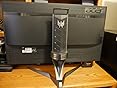
I'm sharing a photot of its back once set on my desk. I’ve cropped in so as not to show my current mess. There are four buttons above the main toggle. I find this a little more confusing to use than the standard toggle-only design other manufacturers implement, however, it does make for far easier access to the power function as there is a dedicated button. The others are shortcuts that I believe can be customized. I mostly prefer to use the toggle and OSD for these purposes, but that will be subjective.
Due to the placement of the buttons, access and pressing them will cause some screen wobble. I don’t know if I like the placement on the right rear verses the bottom center. Either way, it works out alright and is probably not something most users are going to worry or think about for long.
I've included a photo of the front, still powered off. I realize now I didn’t take any shots of it while powered on, other than one to show IPS glow and backlight bleed.
The screen surface is fairly soft and not cloudy as some VA displays tend to be. I don’t think it’s quite as smooth as something like the LG 27GL850, but once powered on you probably won’t notice it. It’s certainly not grainy and doesn’t detract from everyday use.
As for colors, I was able to get them to stick mostly to sRGB by using AMD’s driver setting. This paired with the “warm” setting in the OSD allowed for pleasing color reproduction. I will note there is a slant toward green I couldn’t get away from. This is likely due to how most LED backlit monitors have a more blue hue regardless of color settings. It’s probably a matter of taste and will come down to the user. I myself prefer the sRGB restrictions via AMD’s drivers when using LG’s NanoIPS displays. I feel there was a bit more natural of an element to them, though the ultrawide version is moreso than the 27-inch 27GL850. That display has a bit of harshness you can't get around.
Regardless of the color settings, the Acer does tend to remain skewed more toward a slight green I can’t explain. Users will have to experience it for themselves. I left it on “user” mode after a while just to help offset this a bit without going too blue. It’s hard to tell the difference, and you trade off the easier viewing aspects of the warmer setting. So it’s down to user preference and purely subjective, as I said before. This, however, was impactful enough of an issue I couldn't use it for my workflow in photography and graphic design. It may seem like a flaw to others as it did me. I couldn't manage to calibrate the excessive green cast out of it. That trait is very nuanced and will probably only affect professionals.
I don’t know if I’d adapt well to the greener slant. I was hovering on this aspect myself for a while as I tried to get around it. It alone wouldn’t be enough to turn me away from the model. The following stacked up more against it. I've also shared a photo that shows backlight bleed and IPS glow. I wasn’t able to completely set my camera as I’d have liked, due to time constraints, but I have adjusted it in Photoshop to help show a more accurate representation of these factors. Please remember, these elements will look more pronounced than they actually are in person, and the photo was taken in a fairly dark room.
As you can see, the most notable characteristic is backlight bleed. This was worst in the bottom-right corner. It’s a shame as the blacks really were fairly good. The BLB detracted from darker scenes, whatever the content may be. I deal with a lot of dark scenes in both media and otherwise, so it’s a hard knock against the Acer for me. Working with photography and graphics, you need accuracy, and if the light is negatively impacting this, you end up with a less than stellar experience.
IPS glow is typical and will interfere with enjoyment for some users. I also must note that in spite of the backlight bleed, due to my viewing distance and angle, it’s not as bad as it looks. I sit closer than many users might, which can add to this phenomenon. Yet it was mostly the bottom right that really bothered me. I can’t excuse it, I’m afraid. It was easily the least enjoyable characteristic of the display. Contrast is better than the LG 27GL850 but on par with the LG 34GP83-A-B. This is only marred by the aforementioned bleed and IPS glow. These will depend on your monitor, as always. So some users might luck out with less glow and BLB. I know most reviewers of the Acer mention minimal BLB. So I may well be the outlier here. Unlucky me. In person, it was truly bad.
Uniformity, therefore, in black was not so good. Grey was alright with slight splotchiness, but nothing more than I noticed with the LG 27GL850. Color uniformity was good, as you would expect from an IPS-type panel.
Gamma was good with 2.2 providing something close to right on the 2.2 mark according to Lagom and my eyes. It’s somewhere hovering between that 2.2 and sRGB mark, which is probably as good as you’re going to find. I noticed the same sort of thing with the LG 34GP83-A-B. I think manufacturers are getting better about hitting a good gamma out of the box. Both LG and Acer are probably doing a lot to improve quality control and calibration at the factory.
Pixel density will be worth noting for many. I don’t mind the 91 or so PPI you end up with here. It’s similar to a 24-inch at 1080P, just with a lot more real estate. You’ll probably want to adjust your viewing distance though, which can negate some of the benefit. I didn’t mind sitting the usual 2 to 2 1/2 feet away as I usually do. This allowed for an extra sense of immersion you don’t get from smaller displays of the same resolution. You will miss out on some of the crispness you’d get from a 27-inch at 1440p. So that’s worth noting. It does help with daily use and something as simple as eye comfort though. 1440p on 27 inches results in 109PPI, which can make for very small text, etc. Scaling can help, but then you’re negating the added pixel density in another way. I’d imagine this is less an issue with something in the 4K resolution. With 1440p, your mileage may vary. I’ve found in such use cases I prefer to scale things as they come instead of doing a widespread Windows scaling. For instance, Firefox has rather robust scaling options where you can specify text/and or visual scaling, to what percentage, etc. Discord also has very specific scaling options. I’d like to see more programs/apps provide these options.
Pixel responsiveness is what you might come to expect from a monitor of this day and age at 144Hz (stock) and 170Hz overclocked. You can maintain 170Hz at 10-bit over DP 1.4. I was just happy to see AMD’s drivers reported it as a 10-bit display and allowed that output. Whether this is dithering done in the graphics drivers or on the monitor side, I didn’t see a difference. It was vibrant and very good with gradients, etc. So you’ll probably not care either way. Just remember that without restricting colors to sRGB, you’re going to have oversaturation that may or may not appeal to you. I found this less intense than with LG’s Nano IPS models, but it was still very vibrant and will depend on the user’s preferences. In any case, I don’t think most users will notice the difference between the current Nano IPS panels running at 144Hz with the ideal overdrive setting (I forget which this is) and the Acer XB323U at 170Hz with the same setting in its OSD. Either will look very fast and keep users happy short of those who want insanely high refresh rates. Myself, I’d take this monitor any day over the Samsung G7 at 240Hz. I hear a lot about the early adopter issues with those, and a 1000R curve has no practical use outside of gaming. I’ve no idea what Samsung was thinking. The flat IPS here is ideal in most cases and will make many people more than happy with very fast responsiveness and good enough black levels and contrast.
Last, the OSD is alright, but I found I like how LG’s works better. It displays more current information at first glance with refresh rate, bit depth, and more appearing right away. You have to dig into the Acer OSD to get to these things. The Acer OSD does give a better idea of gamma though with exact number representations instead of just multiple “modes.”
Final verdict: I liked a lot about the Acer XB323U, but the positives couldn’t overcome the backlight bleed and green slant to colors. Acer’s higher build quality and 3-year instead of other manufacturers' 1-year warranty are both positives. Whether you are willing to put up with the green hue or backlight bleed will be up to you. I ended up returning the monitor after trying to make it work for my purposes. I understand many won't notice or care about the green color slant, but the backlight bleed was impossible to overlook. I wonder if manufacturers even test for this before products leave the factory. Even worse, with the backlight being broken up into "zones" for HDR 600 rating, you'd think they'd have done a better job of isolating any backlight issues. This was not the case. For pure media and gaming use with no professional intentions, it might work fine. Though why market a product as 99% Adobe RGB if you aren't also trying to get professionals to buy? I'm a little confounded with that. Old 24-inch 16:10 CCFL backlit monitors had far less backlight bleed. Sometimes I'm tempted just to go back to one and give up on LED if no one can manage a better implementation. At these prices, there's no excuse.
4.0 out of 5 stars
Reviewed in the United States on 4 December 2020
First thing worth noting is that the packaging is quite good. Though Amazon ships without outer packaging now, so the factory box is a little worse for wear. There’s not a lot of tape holding it together either, and some had come loose by the time it arrived.
Once unpacked, you find it arrives completely assembled. The stand doesn’t need put together. It’s also already attached to the display itself. Everything is very sturdy though. The stand is metal with a solid metal base. Some plastic is used for the swivel joint as well as the tilt and rotate. I tested this out, and it does rotate fully to 90 degrees. So if you wanted to use this in portrait mode, you certainly could. I wouldn’t know why though as it’s far too tall vertically in that orientation. Perhaps some users will have a case for this.
I'm sharing a photot of its back once set on my desk. I’ve cropped in so as not to show my current mess. There are four buttons above the main toggle. I find this a little more confusing to use than the standard toggle-only design other manufacturers implement, however, it does make for far easier access to the power function as there is a dedicated button. The others are shortcuts that I believe can be customized. I mostly prefer to use the toggle and OSD for these purposes, but that will be subjective.
Due to the placement of the buttons, access and pressing them will cause some screen wobble. I don’t know if I like the placement on the right rear verses the bottom center. Either way, it works out alright and is probably not something most users are going to worry or think about for long.
I've included a photo of the front, still powered off. I realize now I didn’t take any shots of it while powered on, other than one to show IPS glow and backlight bleed.
The screen surface is fairly soft and not cloudy as some VA displays tend to be. I don’t think it’s quite as smooth as something like the LG 27GL850, but once powered on you probably won’t notice it. It’s certainly not grainy and doesn’t detract from everyday use.
As for colors, I was able to get them to stick mostly to sRGB by using AMD’s driver setting. This paired with the “warm” setting in the OSD allowed for pleasing color reproduction. I will note there is a slant toward green I couldn’t get away from. This is likely due to how most LED backlit monitors have a more blue hue regardless of color settings. It’s probably a matter of taste and will come down to the user. I myself prefer the sRGB restrictions via AMD’s drivers when using LG’s NanoIPS displays. I feel there was a bit more natural of an element to them, though the ultrawide version is moreso than the 27-inch 27GL850. That display has a bit of harshness you can't get around.
Regardless of the color settings, the Acer does tend to remain skewed more toward a slight green I can’t explain. Users will have to experience it for themselves. I left it on “user” mode after a while just to help offset this a bit without going too blue. It’s hard to tell the difference, and you trade off the easier viewing aspects of the warmer setting. So it’s down to user preference and purely subjective, as I said before. This, however, was impactful enough of an issue I couldn't use it for my workflow in photography and graphic design. It may seem like a flaw to others as it did me. I couldn't manage to calibrate the excessive green cast out of it. That trait is very nuanced and will probably only affect professionals.
I don’t know if I’d adapt well to the greener slant. I was hovering on this aspect myself for a while as I tried to get around it. It alone wouldn’t be enough to turn me away from the model. The following stacked up more against it. I've also shared a photo that shows backlight bleed and IPS glow. I wasn’t able to completely set my camera as I’d have liked, due to time constraints, but I have adjusted it in Photoshop to help show a more accurate representation of these factors. Please remember, these elements will look more pronounced than they actually are in person, and the photo was taken in a fairly dark room.
As you can see, the most notable characteristic is backlight bleed. This was worst in the bottom-right corner. It’s a shame as the blacks really were fairly good. The BLB detracted from darker scenes, whatever the content may be. I deal with a lot of dark scenes in both media and otherwise, so it’s a hard knock against the Acer for me. Working with photography and graphics, you need accuracy, and if the light is negatively impacting this, you end up with a less than stellar experience.
IPS glow is typical and will interfere with enjoyment for some users. I also must note that in spite of the backlight bleed, due to my viewing distance and angle, it’s not as bad as it looks. I sit closer than many users might, which can add to this phenomenon. Yet it was mostly the bottom right that really bothered me. I can’t excuse it, I’m afraid. It was easily the least enjoyable characteristic of the display. Contrast is better than the LG 27GL850 but on par with the LG 34GP83-A-B. This is only marred by the aforementioned bleed and IPS glow. These will depend on your monitor, as always. So some users might luck out with less glow and BLB. I know most reviewers of the Acer mention minimal BLB. So I may well be the outlier here. Unlucky me. In person, it was truly bad.
Uniformity, therefore, in black was not so good. Grey was alright with slight splotchiness, but nothing more than I noticed with the LG 27GL850. Color uniformity was good, as you would expect from an IPS-type panel.
Gamma was good with 2.2 providing something close to right on the 2.2 mark according to Lagom and my eyes. It’s somewhere hovering between that 2.2 and sRGB mark, which is probably as good as you’re going to find. I noticed the same sort of thing with the LG 34GP83-A-B. I think manufacturers are getting better about hitting a good gamma out of the box. Both LG and Acer are probably doing a lot to improve quality control and calibration at the factory.
Pixel density will be worth noting for many. I don’t mind the 91 or so PPI you end up with here. It’s similar to a 24-inch at 1080P, just with a lot more real estate. You’ll probably want to adjust your viewing distance though, which can negate some of the benefit. I didn’t mind sitting the usual 2 to 2 1/2 feet away as I usually do. This allowed for an extra sense of immersion you don’t get from smaller displays of the same resolution. You will miss out on some of the crispness you’d get from a 27-inch at 1440p. So that’s worth noting. It does help with daily use and something as simple as eye comfort though. 1440p on 27 inches results in 109PPI, which can make for very small text, etc. Scaling can help, but then you’re negating the added pixel density in another way. I’d imagine this is less an issue with something in the 4K resolution. With 1440p, your mileage may vary. I’ve found in such use cases I prefer to scale things as they come instead of doing a widespread Windows scaling. For instance, Firefox has rather robust scaling options where you can specify text/and or visual scaling, to what percentage, etc. Discord also has very specific scaling options. I’d like to see more programs/apps provide these options.
Pixel responsiveness is what you might come to expect from a monitor of this day and age at 144Hz (stock) and 170Hz overclocked. You can maintain 170Hz at 10-bit over DP 1.4. I was just happy to see AMD’s drivers reported it as a 10-bit display and allowed that output. Whether this is dithering done in the graphics drivers or on the monitor side, I didn’t see a difference. It was vibrant and very good with gradients, etc. So you’ll probably not care either way. Just remember that without restricting colors to sRGB, you’re going to have oversaturation that may or may not appeal to you. I found this less intense than with LG’s Nano IPS models, but it was still very vibrant and will depend on the user’s preferences. In any case, I don’t think most users will notice the difference between the current Nano IPS panels running at 144Hz with the ideal overdrive setting (I forget which this is) and the Acer XB323U at 170Hz with the same setting in its OSD. Either will look very fast and keep users happy short of those who want insanely high refresh rates. Myself, I’d take this monitor any day over the Samsung G7 at 240Hz. I hear a lot about the early adopter issues with those, and a 1000R curve has no practical use outside of gaming. I’ve no idea what Samsung was thinking. The flat IPS here is ideal in most cases and will make many people more than happy with very fast responsiveness and good enough black levels and contrast.
Last, the OSD is alright, but I found I like how LG’s works better. It displays more current information at first glance with refresh rate, bit depth, and more appearing right away. You have to dig into the Acer OSD to get to these things. The Acer OSD does give a better idea of gamma though with exact number representations instead of just multiple “modes.”
Final verdict: I liked a lot about the Acer XB323U, but the positives couldn’t overcome the backlight bleed and green slant to colors. Acer’s higher build quality and 3-year instead of other manufacturers' 1-year warranty are both positives. Whether you are willing to put up with the green hue or backlight bleed will be up to you. I ended up returning the monitor after trying to make it work for my purposes. I understand many won't notice or care about the green color slant, but the backlight bleed was impossible to overlook. I wonder if manufacturers even test for this before products leave the factory. Even worse, with the backlight being broken up into "zones" for HDR 600 rating, you'd think they'd have done a better job of isolating any backlight issues. This was not the case. For pure media and gaming use with no professional intentions, it might work fine. Though why market a product as 99% Adobe RGB if you aren't also trying to get professionals to buy? I'm a little confounded with that. Old 24-inch 16:10 CCFL backlit monitors had far less backlight bleed. Sometimes I'm tempted just to go back to one and give up on LED if no one can manage a better implementation. At these prices, there's no excuse.
Fantastic!
Reviewed in the United States on 19 August 2024
This is probably the best 32" 1440p monitor available hands-down. I like this particular configuration because I do not like how 4K scales with many things on screens this size. Also 4K is especially demanding and makes a lot of games out of reach for even excellent GPUs. This combo makes it possible to have something better than 1080p in a large monitor without the drawbacks of 4K. Namely I can drive it with a little older video card with a little less memory and still get great performance.
This has always been a weird size+resolution combination and was strictly the territory of VA panels for quite a while. I had two of them and both had some sort of reliability issue. I finally moved to IPS when it became available and had a rather reliable but average 75Hz LG. It had that fake "HDR400" thing going on where it was an average brightness monitor but could accept an HDR signal. It wasn't very good for the purpose. This monitor is several cuts above the rest and is hands down the best I could find with the specs and features I wanted. It does everything very well and is a huge upgrade. For my needs it has no downsides.
At 1440p this monitor has similar pixel density to a 24" 1080p screen. Not spectacular but pretty good image quality. Especially so when using MSAA, supersampling, or DLDSR. Having used 32" 1440p for a few years now I can say it gives very respectable clarity in games, even running native with no AA. Great usability at desktop distances. Plenty of screen realestate. Large enough to run two windows side by side. Say writing a word document on one side of the screen while watching a youtube video on the other.
At 170Hz with G-Sync this monitor has very good motion clarity. Obviously not as good as an OLED display but much better than any VA or the 75Hz IPS I had before in the same size. Using the Blur Busters recommended G-Sync setup gets me great results. With a 7900X3D and a 3080Ti, 1440p 120FPS+ is possible in a great many games.
Color is spectacular and several review sites have mentioned how much they like the color capabilities of this monitor. Likewise it will accept a full 1440p 170Hz 10-bit RGB signal. It can be set for sRGB or HDR600 out of the box. And yes this monitor does very solid HDR. It will absolutely hit the 600 nits advertised and can get bright enough to make me squint my eyes. It doesn't have the super sunlight brightness of some really expensive displays but still does a great job in games and movies. It is several steps above your average LCD monitor. It performs best if you go to the 'Image' menu and manually select 'HDR600' instead of the generic 'HDR' setting it uses by default. This is what activates the local dimming which works splendidly. I use Windows 11 with autoHDR and the HDR calibration tool, and my games and movies always look great. I play HDR movies using MPC-BE combined with MadVR.
This is an awesome monitor for this niche size and resolution. High refresh rate, G-Sync, 1440p, and proper quality HDR with local dimming all combine to make it a winner. Unless an OLED comes out in this configuration it is hands down the best monitor of its kind.
From acer
Product Dimensions : 72.75 x 28.91 x 59.69 cm; 10.21 kg
ASIN : B08HSJ7789
Item model number : XB323U Gpbmiiphzx
Guaranteed software updates until : unknown
Customer reviews: 3.6 3.6 out of 5 stars (129) var dpAcrHasRegisteredArcLinkClickAction; P.when(‘A’, ‘ready’).execute(function(A) { if (dpAcrHasRegisteredArcLinkClickAction !== true) { dpAcrHasRegisteredArcLinkClickAction = true; A.declarative( ‘acrLink-click-metrics’, ‘click’, { «allowLinkDefault»: true }, function (event) { if (window.ue) { ue.count(«acrLinkClickCount», (ue.count(«acrLinkClickCount») || 0) + 1); } } ); } }); P.when(‘A’, ‘cf’).execute(function(A) { A.declarative(‘acrStarsLink-click-metrics’, ‘click’, { «allowLinkDefault» : true }, function(event){ if(window.ue) { ue.count(«acrStarsLinkWithPopoverClickCount», (ue.count(«acrStarsLinkWithPopoverClickCount») || 0) + 1); } }); });
Sincronización adaptable
Alto rango dinámico
No account yet?
Create an Account
Valoraciones
Clear filtersNo hay valoraciones aún.